 |
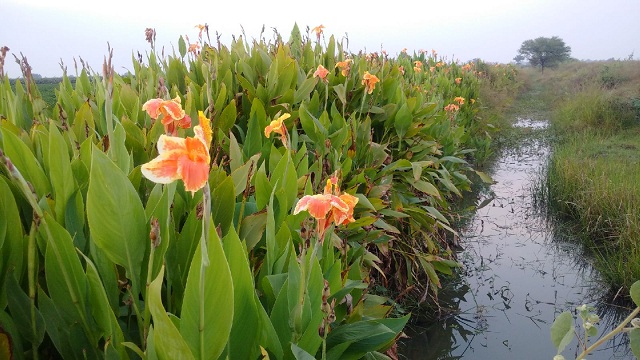
| Canna plant roots can grow even in water-logged soil and dry it up |
| |
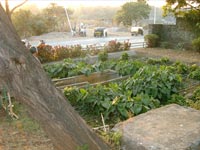 |
| Decentralised wastewater treatment thru cana-beds around a sump for gardening-water, IGIDR Mumbai |
| |
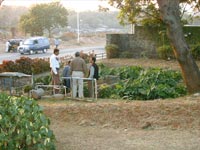 |
| Pumping system for distributing wastewater thru cannabeds |
| |
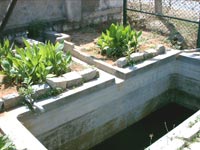 |
| Cleansed wastewater for gardening collects in sump after seeping thru cannabed |
| |
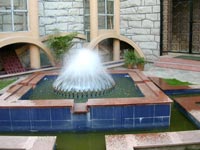 |
| Aeration of wastewater can be done thru decorative fountains |
| |
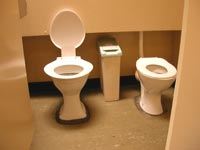 |
| Child-friendly toilet in adult cubicle |
|
Managing mosquitoes, water hyacinth, debris, sewage sludge, blocked drains
In nature, frogs, dragonflies, bats and birds eat flying mosquitoes. Gambusia fish eat larvae in ponds. Avoid stagnant water around hand-pumps. Keep garbage out of drains, keep them flowing.Add a few drops of kerosene or diesel oil onto the surface of stagnant pockets of water so larvae cannot come up to breathe. ALL should do this on the SAME DAY if possible.
|
A Policy for Sustainable Waste-Water Management
India needs to evolve its own set of criteria and policies for natural, low-cost, low-maintenance waste-water treatment systems that do not fail when there are daily and unscheduled power cuts, and do not incur prohibitive power bills, as conventional sewage-treatment plants do.
Despite Massive Investments, Conventional Sewage Treatment Plants Fail
Inner-city space is costly, but decentralised treatment can be done at the neighbourhood level or within the storm-drains themselves, in available spaces.
Sustainable Waste-Water Management Policy
All over India, despite massive investments, conventional waste-water treatment has largely failed. The cost of leading waste-water via Under-Ground Drainage (UGD) to centralized plants is prohibitive.
In-Situ Treatment of Sewage In Urban Storm-Water Drains
In all Indian cities, sewage flows illegally into storm-water drains which were formerly natural water-courses. So all of these empty today into rivers, lakes or city water-bodies, polluting them and causing eutrophication.
Slum Sanitation for Kota
The results of the Kota slum visits have been surprising and revealing to my collleagues in the wastewater, storm-water drainage and water supply sectors.
A Low-Cost Way To Treat Sisamau Sewage
The filthy 100 mld Sisamau outfall at Kanpur has carved out an enormously long and wide channel to the Ganga. Instead of being a river of sewage, the entire bed can be converted to a vastly-adequate series of oxidation ponds, by bunding the bed to give the required 1-1.5 meter depth all along its length."
|
|


